



How Influencer Marketing Is Reshaping Mobile Game User Acquisition

The brandformance channel that used to be a nice-to-have is now a key part of mobile gaming UA. But with second screens and broken ad identifiers, measuring the results of influencers and streams is now more difficult than ever. Here's what's actually happening, why the numbers are harder to read than you think, and how to fix it.
Key Things to Remember
- Influencer marketing has graduated from awareness play to performance channel. In 2025, global gaming UA spend hit $25 billion, and creator-led campaigns are increasingly competing for the same budget line as Meta and Google, taking their share.
- Attribution is the bottleneck. The second-screen problem, in-app browsers swallowing deep links, and delayed installs mean that click-based attribution consistently undervalues influencer campaigns by an estimated 2–4×.
- Organic lift is the hidden ROI. A properly instrumented multichannel attribution setup, like combining MMP data, organic install baselines, and time-series analysis, routinely reveals that 40–60% of influencer-driven installs never touch a tracked link.
- The winners are treating IM like a data product. That means QR codes on every YouTube integration, baseline modeling before every flight, creator-level LTV cohorts, and creative intelligence tools like Apptica to benchmark against competitors' campaigns in real time.
Сreative video for Diablo Immortal, available for analysis in Apptica’s Ad Intelligence.
From Supporting Act to Strategic Cornerstone
Three years ago, a typical mobile game publisher treated influencer marketing as a top-of-funnel awareness lever: useful for launches, hard to measure, and therefore hard to scale. That dynamic has shifted — and it shifted fast.
Among the key marketing trends these years, influencer marketing moved from a supporting role to a strategic cornerstone for top publishers in 2024, driven not just by visibility but by performance, retention, and long-term engagement. When the AppsFlyer State of Gaming report shows that paid install share rose 10% YoY and ad impressions jumped 20%, flooding every acquisition channel with creative variations, the appeal of a channel that bypasses banner blindness entirely becomes obvious.
Several structural forces are accelerating this shift.
The attention ceiling is real. Top gaming advertisers now produce 2,400–2,600 creative variations per quarter, a 25–30% increase year-over-year driven largely by AI. Production got cheaper; attention didn't get more abundant. When your competitors are carpet-bombing the same ad networks, a trusted creator showing actual gameplay to an audience that voluntarily opted in starts looking less like a brand play and more like a defensible performance channel.
Privacy changes rewired the incentives. Post-ATT, iOS advertisers increased the number of media sources they use by up to 15% YoY. That diversification is born not of curiosity, but of necessity. As deterministic user-level attribution erodes, channels where the trust signal comes from the creator (not the tracking pixel) gain structural advantage.
Creator content drives better downstream metrics. AppsFlyer's 2023 data found that UGC-style creatives bring the highest retention rates among all creative formats in gaming. This makes intuitive sense: a user who downloads because they watched a creator demonstrate real gameplay arrives with accurate expectations. They don't churn because the game isn't what the misleading playable ad promised.
The genre breakdown tells its own story. RPGs, MMOs, and strategy franchises like Raid: Shadow Legends, Honkai: Star Rail, Marvel Strike Force are the heaviest investors in influencer marketing, using creators as a primary growth lever. But the trend is bleeding into casual and hybrid-casual as well, particularly as publishers shift toward micro-influencer activations. The 2026 playbook, as Mega Digital's analysis notes, favors activating hundreds of micro-influencers simultaneously over spending the same budget on a single macro creator.
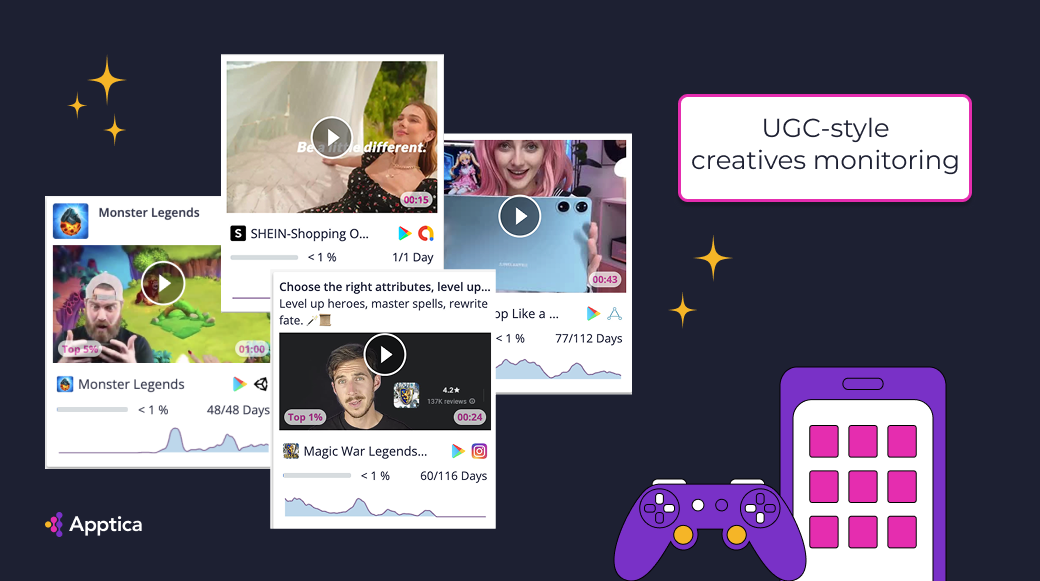
For UA teams trying to understand what their competitors are doing in this space — which creators they're partnering with, what ad formats they're testing, and which networks they're buying through — tools like Apptica's Ad Intelligence become essential. Competitive creative monitoring at scale is no longer a "nice-to-have" when creator content is being repurposed as paid media across entire platform ecosystems.
UGC-style creative video for Magic War Legends: Tactics RPG, available for analysis in Apptica’s Ad Intelligence.
The Attribution Black Hole
Here's the uncomfortable truth that every UA team running influencer campaigns knows but few talk about openly: your MMP is dramatically under-reporting the value of your influencer spend. This is a structural limitation of how click-based attribution works for a channel that fundamentally doesn't behave like a click-based channel.
Let's walk through the specific failures.
The Second-Screen Problem
The majority of YouTube gaming content is now consumed on desktops, laptops, and smart TVs, not on mobile devices. This ongoing shift of viewers to larger screens is precisely why QR codes have become an industry standard for gaming integrations. But even with QR codes, you're relying on the viewer to physically pick up their phone, open the camera, scan, and follow through. That's a high-friction conversion path compared to a tap on an in-feed ad.
What happens in practice: a viewer watches a creator play your game on their desktop. They're interested. They don't scan the QR code. Later that evening, they search for your game directly in the App Store. Your MMP records this as an organic install. Your influencer campaign, which generated the intent, gets zero credit.
In-App Browsers and Broken Deep Links
When a viewer does tap a link from a creator's content on mobile, the destination is almost never the App Store. It's the platform's in-app browser — YouTube's, TikTok's, Instagram's — each with its own WebView that handles links differently. As AppsFlyer documented after deep links broke across X's iOS app, a single WebView update can silently kill your entire conversion funnel. The link opens, nothing happens, the user gives up. Your MMP never fires.
The problem is systemic. URLgenius and similar deep-linking solutions exist precisely because social platforms keep users within their walled-garden browsers, preventing direct app-store redirects. Even with deferred deep linking properly configured, each platform's WebView has its own quirks. Testing a link on Android Chrome tells you nothing about how it will behave inside TikTok's iOS in-app browser.
The Delayed Install Gap
Not every conversion is immediate, and with influencer marketing, the delay is structural, not incidental. Apptamin notes that install attribution is significantly trickier with influencer marketing: some users click links directly, but many come to the app later. A viewer might watch a creator's video on Monday, think about it, and search for the game on Thursday. Standard attribution windows (24h click, 7d view-through) will miss a significant portion of these conversions.
MobileAction's analysis reinforces this: after watching an influencer campaign, many players don't tap a direct link at all. Instead, they search for the game name or related terms later. If your ASO isn't optimized for those branded search terms, you lose the install entirely. And if the install does happen via organic search, your attribution system credits it to ASO, not to the creator who generated the intent.
What Does This Mean For You
The cumulative effect of these failure modes is that a UA team looking at their MMP dashboard sees influencer campaigns delivering a CPI that's 2–4× higher than what the channel is actually producing. They compare it to the neatly attributed CPI from their Meta or Google campaigns (which have their own over-attribution problems, but that's a different article), and the influencer budget gets cut. The team then wonders why their organic install volume mysteriously drops two weeks later.
This is a strategic miscalculation that leads to systematically under-investing in one of the few channels where trust, not targeting, drives the conversion.
Seeing the Full Picture: A Multichannel Attribution Approach
So if standard click-based attribution can't capture the real value of influencer campaigns, what can? The answer is a layered measurement framework that combines multiple signals. Here's what a well-instrumented approach looks like in practice, built around a hypothetical (but realistic) campaign for a midcore mobile game.
Setting the Baseline
Before your first creator video goes live, you need to know what "normal" looks like. Using your MMP data (AppsFlyer, Adjust, Singular — take your pick), pull the daily organic install volume for your target geos over the past 60–90 days. Strip out any periods where other campaigns (a new ad creative test, an App Store feature, a seasonal event) could have spiked organic numbers. What you're left with is your baseline: the install volume you'd expect to see if you did nothing.
This is, in effect, a simplified version of what Upptic calls baseline modeling: establish the organic traffic baseline when ad spend is zero (or stable), then measure the deviation. If paid influencer spend goes up and "unattributed" organic traffic rises in correlation, the delta is your organic uplift.
The Campaign Flight
Your campaign launches: 15 mid-tier YouTube creators (50K–500K subscribers each) publish integrations over a 10-day window. Each creator has a unique tracking link (via your MMP) and a unique QR code. Separately, you've tagged each campaign flight in Apptica to monitor how competitor activity in your genre behaves during the same period: you need to distinguish your organic lift from a market-wide trend.
Measuring the Three Layers
Layer 1: Directly attributed installs. These are the clicks through your tracked links and QR codes that your MMP successfully captures. In a typical YouTube campaign for a midcore game, this might represent 30–40% of the actual installs the campaign generated. It's the most granular data you'll have — you can tie these installs to specific creators, calculate per-creator CPI and Day-7 retention, and build LTV cohorts. Treat this as your optimization signal.
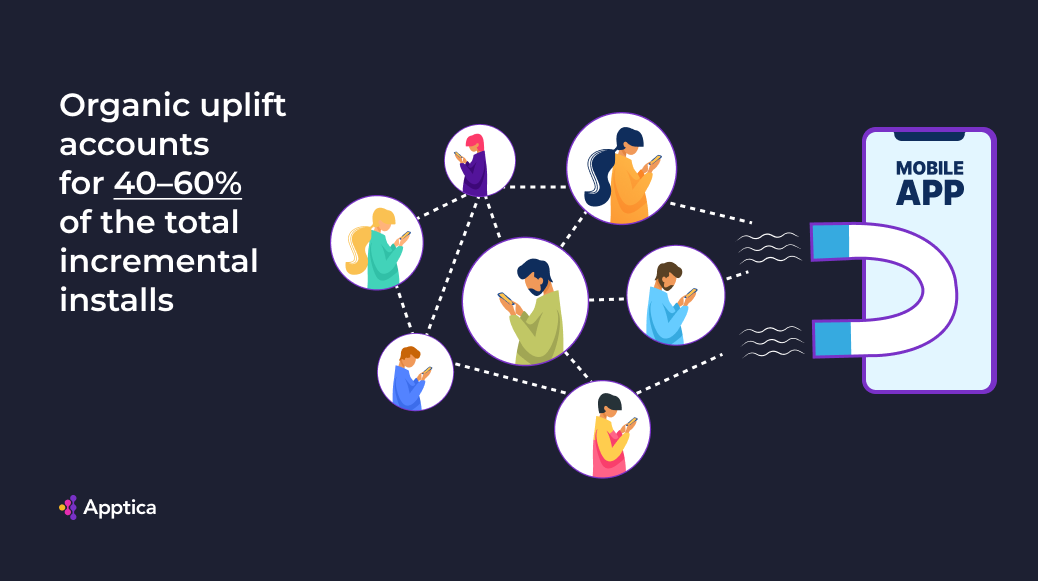
Layer 2: Organic uplift. During and immediately after the campaign flight, your daily organic installs in the target geos will rise above baseline. The magnitude varies — we've seen campaigns where organic uplift accounts for 40–60% of the total incremental installs. Time-series analysis is the tool here: compare the observed organic installs to the counterfactual baseline, controlling for day-of-week effects and any concurrent activity. Adjust's incrementality framework provides a solid conceptual foundation: you're asking, "what would have happened if I didn't run this campaign?"
Layer 3: Branded search and ASO spillover. A well-executed influencer campaign doesn't just drive installs — it drives search volume. Monitor your branded keyword rankings and search volume in the App Store and Google Play during the flight window. If you see a spike in branded search installs that correlates with the campaign timing, that's additional influencer value that no click-based system will capture. This is where Apptica's Store Intelligence is particularly useful: tracking keyword ranking shifts and download trends over time to see the ripple effects of an influencer push.
Assembling the Picture
When you combine all three layers, the unit economics of your influencer campaign look dramatically different. A campaign that your MMP says delivered a $12 CPI (based on directly tracked installs alone) might actually deliver a blended CPI of $4–5 when you account for organic lift and branded search spillover. Moreover, the cohort quality is typically higher: users who arrived with accurate gameplay expectations retain better and monetize more predictably.
The key insight from INCRMNTAL's work on measuring influencer marketing incrementality is that you don't need perfect measurement — you need directionally accurate measurement that's good enough to make budget allocation decisions with confidence. A 90% accurate picture of your influencer ROI beats a 100% accurate picture of only the 35% of installs your MMP can see.
Making It Work: Best Practices for IM in Mobile Game UA
The strategic case for influencer marketing in mobile gaming is clear. The attribution challenges are real but solvable. So what separates the teams that scale this channel profitably from the ones that run a few test campaigns and move on?
Build the Measurement Stack Before the First Campaign
This is the single most common failure mode: a UA team negotiates a creator deal, ships content, looks at the CPI in their MMP, and concludes the channel doesn't work. The measurement infrastructure — baseline modeling, organic uplift tracking, branded search monitoring — needs to be in place before the first video goes live. You can't retroactively reconstruct a counterfactual baseline.
Practically, this means coordinating between your UA team (for MMP data), your ASO team (for keyword and ranking data), and your market intelligence tools. A platform like Apptica can serve as the connective tissue: its Ad Intelligence lets you track both your own and competitors' creative deployment, while Store Intelligence captures the download and ranking effects that result.
Adopt Creator-Level LTV Cohorts
Stop evaluating creators solely on CPI. A creator whose audience generates a $3 CPI with 18% Day-7 retention is more valuable than a creator whose audience generates a $1.50 CPI with 8% Day-7 retention. This is obvious in theory and almost never done in practice — partly because the measurement gaps described in Section 2 make it hard to build clean per-creator cohorts.
The fix: use unique tracking links per creator (not per campaign), append unique promo codes that can be redeemed in-game (capturing even users who installed via organic search but remembered the creator's code), and build cohort dashboards that track these users through to Day-30 and beyond. The goal is creator-level unit economics, not campaign-level averages.
Match the Format to the Platform — and the Screen
The 60–90 second YouTube integration remains the highest-performing format for mobile gaming by ROAS. But as content consumption shifts to larger screens, the call-to-action needs to adapt. QR codes are now table stakes for YouTube campaigns. For TikTok and Reels, where users are already on mobile, the conversion path is different: short-form content with a clear in-video CTA that drives an immediate App Store search (because the in-app browser will likely break your deep link anyway).
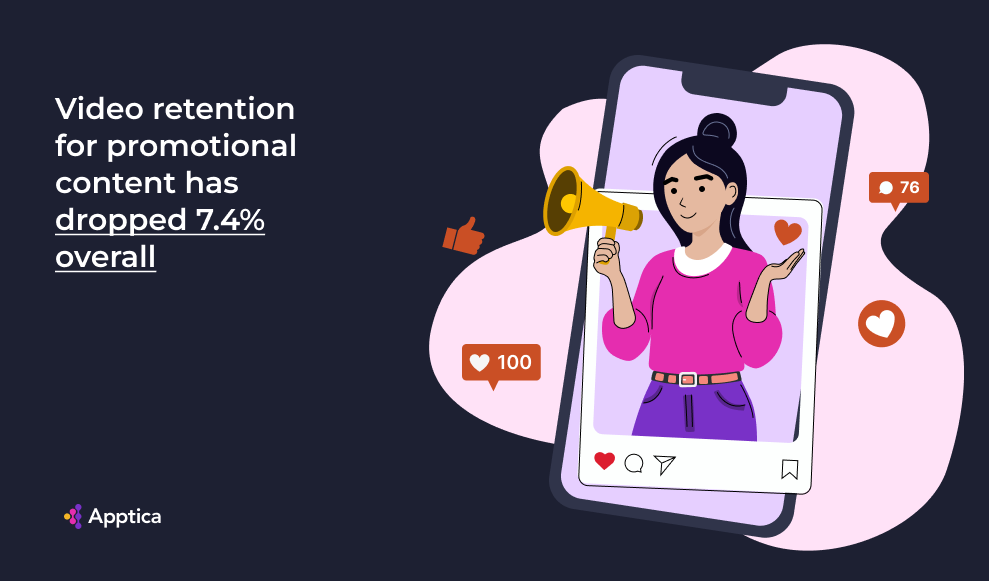
The best-performing campaigns structure their creator briefs around moments that look native to the platform. A YouTube strategy game integration should feel like part of the creator's regular video essay, not a mid-roll interruption. A TikTok casual game activation should look like a genuine "first reaction" clip. Audiences have become extremely skilled at detecting forced integrations, and the data shows it: video retention for promotional content has dropped 7.4% overall, though retention for well-integrated sponsored segments remains steady.
Use Creative Intelligence to Close the Competitive Loop
One underutilized advantage of influencer marketing is that it's visible. Your competitors' creator campaigns are public — you can see which creators they work with, what formats they use, and how audiences respond. But doing this manually at scale is impractical. This is where Apptica's Creative Gallery becomes a genuine operational advantage: it lets you monitor millions of ad creatives across ad networks, filtering by category, geography, and advertiser. When a competitor starts a new creator campaign wave, you see it — and you can reverse-engineer the brief from the output.
The teams that scale influencer marketing most effectively treat competitive creative analysis as a continuous input to their own strategy, not a quarterly benchmarking exercise. They watch what competitors test, see what sticks (measured by creative longevity and share of voice), and adjust their own creator briefs accordingly.
Think in Flighting Cycles, Not One-Off Deals
The data consistently shows that influencer campaigns perform best when aligned with in-game events, new features, or seasonal moments — because they give creators a concrete angle and viewers a specific reason to install now rather than "sometime." Structure your influencer calendar around your live-ops calendar. Build a bench of 30–50 creators you can activate for different flight windows. Negotiate framework agreements that allow for fast turnaround when a new event drops.
This also makes measurement cleaner: discrete campaign flights with clear start/end dates produce sharper organic lift signals than continuous low-level creator activity.
The Bottom Line
Influencer marketing for mobile games has outgrown the "it's just awareness" narrative. It is, increasingly, a high-LTV acquisition channel — but one whose true ROI is hidden behind attribution infrastructure that was built for a different kind of marketing.
The teams that unlock the full value of this channel are the ones that invest in measurement before they invest in creators: baseline modeling, organic uplift analysis, creator-level cohort tracking, and competitive intelligence via platforms like Apptica. The teams that don't will keep under-investing in the channel, over-investing in saturated ad networks, and wondering why their organic installs fluctuate with no apparent cause.
The cause is right there: it's just in a YouTube video you didn't attribute.